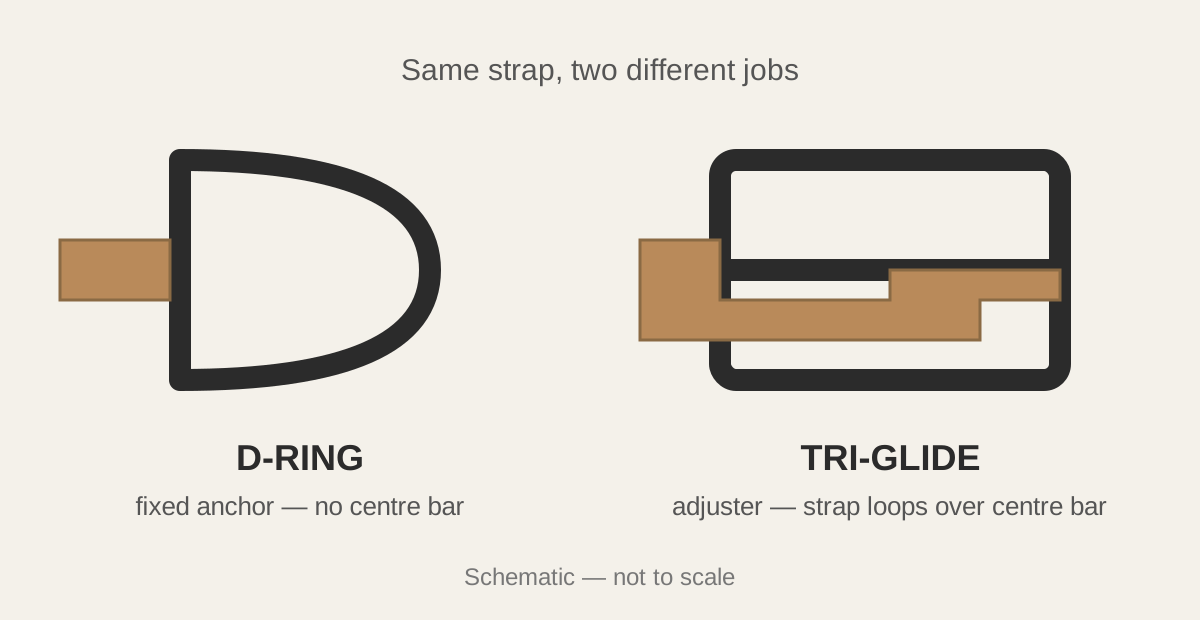
1. The short answer
If the strap has to change length and stay at the new length, use a tri-glide. If you need a fixed point to clip something to, hang something from, or pull a strap through, use a D-ring.
That is the whole decision, and it comes before size, finish, or material. A D-ring used as an adjuster will not hold a length, because there is nothing in it to grip the strap. A tri-glide used as a fixed anchor gives you a moving part where you wanted a fixed one.
Start from the job. Then check size. In that order.
2. How each one works
A D-ring is a loop shaped like a D: a curved side and one straight bar. The strap goes through the loop and the straight bar is the side it sits against. Nothing in a D-ring adjusts. It is an anchor, and it stays where it is put.
A tri-glide is a rectangle with a bar across the middle. The strap goes in one side, loops over that centre bar, and comes back out the other side. Friction on the centre bar is what holds the length. Slide the strap and the length changes; leave it alone and it stays.
That centre bar is the difference. No centre bar, no adjustment. If you are looking at a piece and cannot find the centre bar, you are looking at an anchor, not an adjuster.
3. Measure both the same way, then add one check
For both pieces, start with inner width. Measure inside edge to inside edge, the way you would for a buckle. The strap has to pass through that inside space. Outer size tells you nothing about whether the strap fits.
For a D-ring, also check inner height and wire diameter — whether the wire is round or flat, and how thick it is. A strap that fits the width but cannot clear the height, or that has to bend hard over a thick wire, is not fitted yet.
For a tri-glide, also check thickness at the fold. The strap passes over the centre bar, so the slot has to take the strap folded back on itself, not just the strap lying flat. Measure the strap where it folds, doubled, and compare that against the slot. A tri-glide that takes a flat strap and jams on a folded one was measured the wrong way.
| Point | D-ring vs tri-glide |
|---|---|
| Job | D-ring: fixed anchor point. Tri-glide: adjustable strap length. |
| Centre bar | D-ring: none. Tri-glide: yes — the strap loops over it. |
| First measurement | D-ring: inner width, then inner height. Tri-glide: inner width, then thickness at the fold. |
| Fails when | D-ring used as an adjuster. Tri-glide used as a fixed anchor. |
4. When each one wins
Use a D-ring when the strap ends at a fixed point: a bag strap clipping to a bag body, a lead clipping to a collar, a strap pulling through a loop to close. The point does not move, and that is the point.
Use a tri-glide when the wearer or the load changes the length: a shoulder strap that gets longer and shorter, a bag strap that adjusts between carrying positions, any strap that has to be resized in use without tools.
Some straps need both, and that is normal. A bag strap can run through a tri-glide to set its length and end at a D-ring to clip on. That is not a contradiction — it is two jobs, each with its own piece. What does not work is asking one piece to do both jobs.
5. Three mistakes that waste an order
First, ordering by outer size. Outer width is always bigger than the inside the strap actually uses. Order by that number and the strap will not fit, on either shape.
Second, fitting a tri-glide on a flat strap measurement. The strap folds over the centre bar in use. If you only measured it flat, the first adjustment will jam.
Third, swapping the jobs. A D-ring on an adjustable strap slips because nothing grips it. A tri-glide as the only anchor on a load-bearing point moves when it should stay put. If a strap keeps slipping or keeps moving, check whether the piece matches the job before you blame the size.
6. If you are asking someone else to make or supply it
Send these and you will skip most of the back-and-forth:
- Which job it is — fixed anchor or adjustable length — and where on the strap it sits
- Strap width, in millimetres, and the inner width it has to match
- For a D-ring: inner height and wire shape and diameter
- For a tri-glide: strap thickness at the fold, doubled
- One straight photo of the old piece next to a ruler, if you are replacing one
That is enough to check whether a standard size fits or whether it needs a different shape. Finish and material come after fit and job, not before them.
This is a choosing method, not a product test. No specific ring, maker, or material result is claimed here. If a listing does not say whether its size is inner or outer width, ask before you order.
Varestaq is an independent sourcing and product development partner based in China. Manufacturing partners are evaluated for each project; we do not operate a factory. Supplier capability, compatibility, MOQ, tooling requirements and lead time must be verified against your actual requirements before commitment.
Discuss your part, drawing or specification