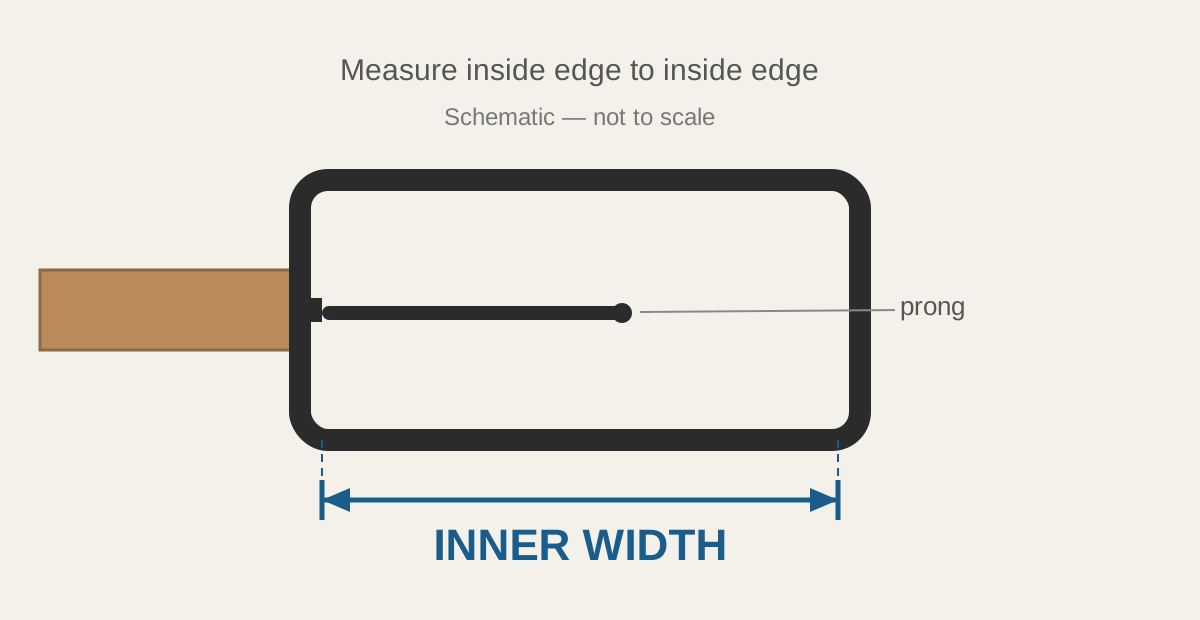
1. Start with inner width
Take the buckle off the strap first if you can. On the strap, the leather fills the frame and makes the inside look wider than it is.
Lay the buckle face down. Measure straight across, inside edge to inside edge, at the end where the strap enters. Leave the frame metal out of it. That number is your size.
A buckle sold as 38 mm should read about 38 mm here. A 38 mm strap should slide through with a little play — snug, not forced, not rattling.
The mistake that comes up most often is measuring the outside. Outside width is always bigger, by the frame thickness on both sides. Order by that number and the replacement shows up too big for your strap, every time.
2. Then check the pin
Inner width gets you most of the way, but the pin still has to work.
Single pin is the usual belt buckle: one pin, one hole. Double pin means two pins, and those two pins need two holes at the right distance apart — measure pin to pin, centre to centre, before you order anything. A roller buckle closes the same way as a single pin, but the frame is shaped differently, so note that it is a roller.
Pin length matters too. Measure from the hinge to the tip. Too short and it will not reach through a thick strap. Far too long and it sticks out past the frame and catches on things.
3. Do not forget thickness
Width can match and the buckle can still fail. That happens when the strap is too thick for the gap inside the frame.
Measure the strap where it goes into the buckle, with a caliper if you have one. Then look at the gap between the frame and the bar or roller inside. The strap has to pass through that gap without being crushed. Padded ends and doubled ends count here — if your strap is thick at the end, that is part of the size, not an afterthought.
4. A rough size reference
Buckle makers do not all step their sizes the same way, so use this as a starting point, not a rule. If you land between two sizes, measure again instead of rounding. One or two millimetres is enough to change the fit on a narrow strap.
| Strap width | Common buckle inner width |
|---|---|
| 25 mm, about 1 inch | 25 mm |
| 32 mm, about 1.25 inches | 32 mm |
| 38 mm, about 1.5 inches | 38 mm |
| 44 mm, about 1.75 inches | 44 mm |
Strap width itself is measured at the buckle end, not the widest point.
5. Three mix-ups that waste an order
First, belt size is not buckle size. A belt marked 34 or 36 is talking about waist size. Ordering a buckle by that number will not work.
Second, a jeans size chart is not a buckle size chart. A lot of what comes up for “belt buckle size chart” is actually clothing sizing. If a chart asks for your waist or your jeans size, it is not measuring a buckle. A real buckle chart starts from inner width.
Third, outside width again, because it keeps happening. When you ask anyone about a replacement, say inner width out loud, in millimetres, and ask them to confirm their size is inner width too. Not every listing says which one it means.
6. If you are asking someone else to make it
Send four things and you will skip most of the back-and-forth:
- Inner width, in millimetres
- Pin type — single, double, or roller — and pin spacing if it is double
- Strap width and strap thickness
- One straight photo of the old buckle next to a ruler
That is enough to check whether a standard size fits or whether it needs to be made to order. Finish and material come after fit, not before it.
This is a measuring method, not a product test. No specific buckle, maker, or material result is claimed here. If a listing does not say whether its size is inner or outer width, ask before you order.
Varestaq is an independent sourcing and product development partner based in China. Manufacturing partners are evaluated for each project; we do not operate a factory. Supplier capability, compatibility, MOQ, tooling requirements and lead time must be verified against your actual requirements before commitment.
Discuss your part, drawing or specification