1. The problem is the measuring point, not the label
A strap width that does not fit was usually not bought in the wrong width. It was measured in the wrong place.
That is the most useful way to think about strap width for leather belts. A strap and a fitting each carry a width number, but those two numbers only match if they were measured in the same place. A strap sold as one width does not sit cleanly in a fitting sold as the same width if the strap was measured at its widest point and the fitting was measured at the point where the strap enters it. The label matches. The fit does not.
So start from where the strap enters the fitting, not from the catalogue label. What width is the strap at the end that goes into the buckle? What inner width does that fitting actually offer at that same point? If you can answer those two questions, most strap problems go away before you order.
2. Measure strap width at the buckle end
How to measure strap width for buckle fit comes down to one point: measure at the buckle end.
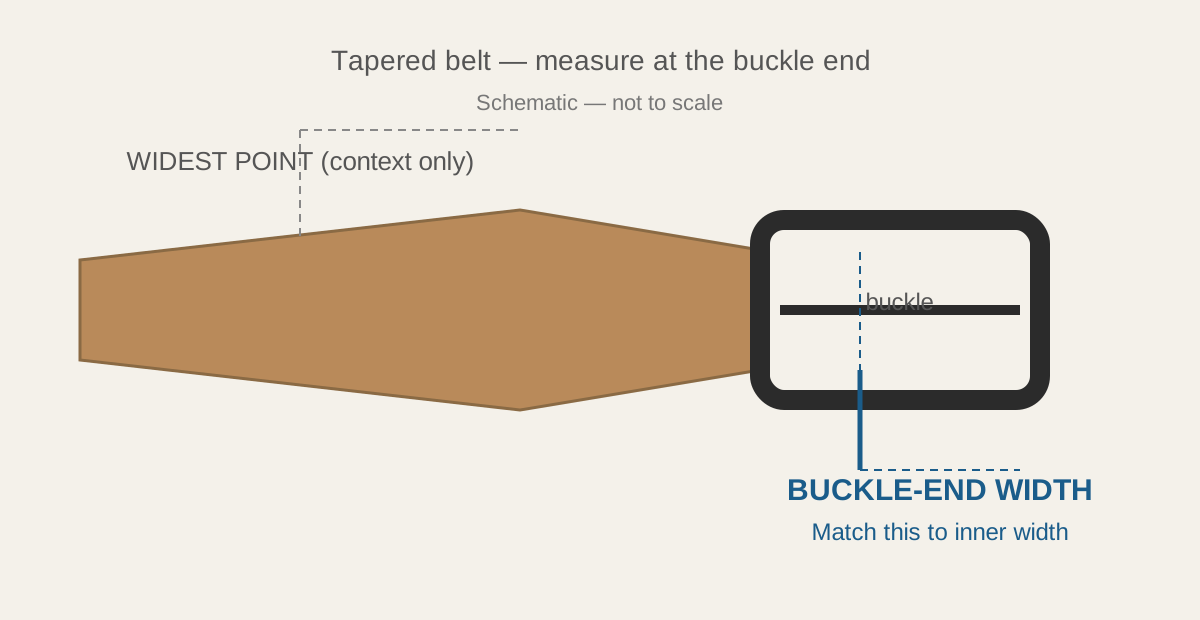
Measure the strap width at the end that enters the buckle, inside the fitting's path — not at the belt's widest point. On a tapered belt, the buckle-end width is the number that has to match; the widest point is irrelevant to fit. A tapered belt is wider in the middle on purpose, for looks or for comfort, and that wider middle never passes through the buckle. Measuring there tells you how the belt looks on the waist. It tells you nothing about whether it will pass through the frame.
Measure flat, without stretching the strap, at the buckle end, and write the number down in millimetres. If the belt tapers, write the buckle-end width first and the widest point second, clearly labelled as context only. A maker who receives only the widest point will size the fitting to a width the strap never presents at the buckle, and the strap will either bind or sit loose.
3. Match strap width to inner width
The strap has to pass through the fitting's inner width and lie flat. Inner width is measured inside edge to inside edge, at the end where the strap enters the frame. Leave the frame metal out of it. That is the clear space the strap has to pass through.
Outer width is a different number and it fools people. A frame that measures wider across the outside can still have a narrower inner width, and a strap wider than that inner width will not go through it no matter how good the buckle looks. State both numbers, in millimetres, and check strap width against inner width only.
This is the same rule already published for bag straps: match the strap width to the inner width, not to the outside of the fitting. The full buckle-side method — inner width, pin type, and strap thickness as buckle sizing — is covered in the brass-buckle guide and the belt-buckle measuring guide, and this article does not re-teach it. Here the point is only the strap side: hand over the buckle-end width, and check it against the inner width, not against any other number on the listing.
4. Width alone is not enough: thickness at the hole
Width gets the strap through the frame. Thickness gets the pin through the strap. The two have to be handed over together.
The pin has to go through the strap, so thickness at the hole position matters alongside width. Measure thickness where the pin passes through, with both layers together if the strap is folded there, and hand over width and thickness together. A strap that is the right width but too thick for the pin length will not close properly. A strap that is the right width but too thin for a heavy prong will stretch at the hole.
This is not a pin-type lesson. Pin types — single, double, and plate — and which one a strap needs belong to the brass-buckle guide. Here the belt buckle pin only enters as a thickness check: whatever pin the buckle carries, it has to pass through the strap at the hole position, and the strap has to be thick enough at that point not to stretch out of shape. If a size chart only lists width, that chart is not enough to order from. Ask for the thickness range, in millimetres, for that exact buckle.
5. Belt vs bag strap: same rule, different pull
A belt takes a straight pull and is adjusted often. A bag strap hangs, swings, and gets pulled at an angle when the bag is carried. The measuring rule does not change — buckle-end width against inner width, plus thickness at the hole — but the product and the pull in use still have to be named when asking for a fitting, so the sample is checked on that product, not on a scrap.
A buckle that holds fine on a belt can work loose on a bag strap if the prong and bar were never checked against that angled pull. A strap that fits a belt buckle on a bench can bind on a bag strap if the strap is checked only at its widest point. Name the product first, then the pull, then the numbers. The numbers do not change with the product, but the check does: a sample checked on the finished belt, or on the finished bag strap, is the only check that counts.
6. What to send, and quick answers
If you are asking someone else to make or supply a fitting for a leather belt, send these and you will skip most of the back-and-forth:
- Strap width at the buckle end, in millimetres
- Whether the belt is tapered, and what the widest point is — for context only, not for fit
- Strap thickness at the hole position, with both layers together if the strap is folded there
- The fitting's inner width the strap must pass through
- The product it goes on, and how the strap will be pulled in use
Is the listed width the buckle-end width? Not necessarily. Ask where it was measured. A listing that gives only one width, without saying where, has not given you a fit number yet.
Does a wider belt need a wider buckle? Only if the buckle-end width is wider. The widest point does not decide it. A tapered belt with a wide middle and a narrow buckle end needs a buckle sized to the buckle end.
Why does a strap that "matches" still not lie flat? Because one of the two widths was an outer width, or the width was taken at the wrong point. Check both: strap width at the buckle end, against inner width, in millimetres.
This is a choosing method, not a product test. No specific buckle, maker, or material result is claimed here. If a listing does not say where its width was measured, ask before you order.
Related guides
Varestaq is an independent sourcing and product development partner based in China. Manufacturing partners are evaluated for each project; we do not operate a factory. Supplier capability, compatibility, MOQ, tooling requirements and lead time must be verified against your actual requirements before commitment.
Discuss your part, drawing or specification