1. The problem is pin type and size, not colour
A brass buckle that does not work was usually not bought in the wrong colour. It was bought with the wrong pin type for the strap, or in the wrong size for the belt it has to close.
A buckle is a closure and a fitting in one: it has to hold the strap, take the pull in use, and let the strap pass through and lie flat. A finish that matches your leather tells you nothing about any of those jobs.
So start from the strap, not from the catalogue page. What kind of pin does this strap need? What inner width does the strap need to pass through? How thick is the strap at the point where the pin has to go through it? If you can answer those three questions, most buckle problems go away before you order.
2. Pin types first — single, double, and plate
Belt buckle pin types are worth settling before size, because the pin decides how the buckle grips the strap, and a size that is right for one pin type can be wrong for another.
A single-prong buckle has one prong that goes through one hole in the strap. It is the simplest setup, and it suits a belt that gets adjusted often and pulled in a straight line. The strap hole takes the pull, so the hole has to be clean and the strap has to be thick enough at that point not to stretch out of shape.
A double-prong buckle has two prongs that go through two holes, side by side. The pull spreads across two holes instead of one, which helps on a wider belt and on a belt that gets pulled hard or at an angle. The trade-off is exactness: the two holes have to line up with the two prongs. A double-prong buckle on a strap too narrow for it is worse than a single prong, not better.
A plate-style buckle fixes the prong to a plate or bar across the frame, not to the frame edge. The strap bends differently over the bar, and the thickness the bar can take is its own number — ask for the bar clearance, in millimetres, for that exact buckle.
The practical rule is short. Name the pin type first. Then check the strap against that pin type: one hole or two, and whether the strap is wide enough and thick enough for the prongs it will carry. Size comes after the pin type, not before it.
| Pin type | What it suits and what to check |
|---|---|
| Single prong | A belt adjusted often and pulled straight; hole must be clean and the strap thick enough not to stretch |
| Double prong | A wider belt or a hard pull; strap must be wide enough for both prongs and both holes must line up |
| Plate / centre-bar | A prong fixed to a plate or bar; check bar clearance in millimetres for that exact buckle |
3. Brass buckle sizes: inner width, pin, and thickness
Custom brass buckle sizes only mean something when they are stated as three numbers together: inner width, pin type, and strap thickness. A single number — "35 mm" or "38 mm" — on its own does not tell you whether a buckle fits, because it does not say which measurement it is.
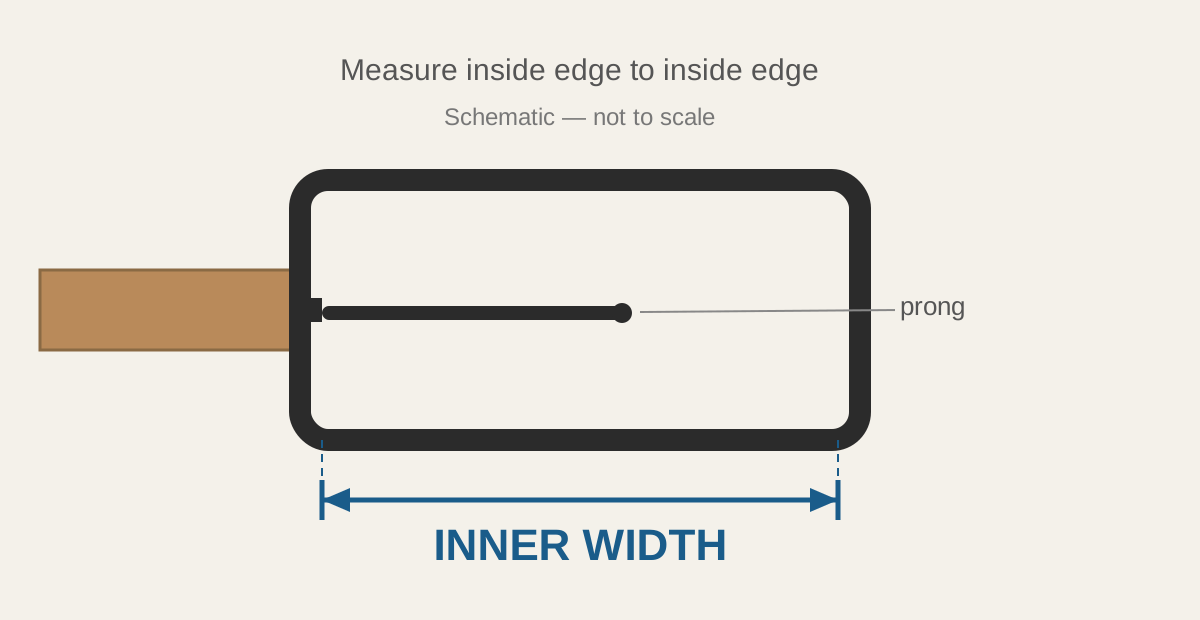
Inner width is the number that decides fit. Measure it inside edge to inside edge, at the end where the strap enters the frame. Leave the frame metal out of it. That is the clear space the strap has to pass through. If your strap is 38 mm wide, the inside of the frame needs to be a full 38 mm wide for the strap to pass through and lie flat. The outside width of the frame is a different number, and it is the one that fools people: a frame that measures 50 mm across the outside can still have an inner width of only 38 mm, and a strap wider than that inner width will not go through it no matter how good the buckle looks.
Strap width is measured against the inner width it has to fit, at the point where the strap enters the buckle — not at the belt's widest point. On a tapered belt, it is the buckle-end width that has to match.
Strap thickness is the third number, and it is the one people skip. The pin has to go through the strap, and the bar or plate has to take the strap folded over it. A strap that is too thick for the pin length will not close properly; a strap that is too thin for a heavy prong will stretch at the hole. Measure the strap thickness at the hole position, with both layers together if the strap is folded there, and check it against the pin length and the bar clearance for that exact buckle. If a size chart only lists the outer width, that chart is not enough to order from. Ask for inner width, pin type, and the thickness range, in millimetres, for that exact buckle.
4. Ask about the material piece by piece
A brass buckle is not one piece of metal, so a single material word for the whole buckle hides the pieces that matter. The frame, the prong, and the pin or bar are separate pieces, and each one needs its own material answer.
That is why "solid brass" on a listing, without a breakdown, is not a settled claim. It may describe the frame and say nothing about the prong or the bar. Ask before you treat it as settled: what is the frame made of, what is the prong made of, and what is the bar or pin made of? If a grade is given, ask which piece it applies to.
Finish is a separate question from material, and it has to stay separate. A colour — bright, antique, brushed, black — is a surface finish. It tells you how the buckle looks, not what each piece is made of. A gold-coloured buckle is not automatically a brass buckle, and a brass-coloured finish on another metal is not brass. Ask material per component, in writing, and keep the answer with the order. If a part's material is not confirmed, say it is not confirmed.
The checks that tell solid brass from brass-plated hardware — and what each check can and cannot prove — are in our guide to telling the two apart.
5. Match the buckle to the product, not the other way round
A belt and a bag strap do not ask the same thing of a buckle, so they should not automatically get the same buckle.
A belt buckle takes a straight pull, gets adjusted often, and the strap hole takes the load every time the belt is fastened. A single prong usually suits a standard belt; a double prong suits a wider belt or one that gets pulled hard, as long as the strap is wide enough for both prongs and the two holes line up.
A bag strap buckle takes a different pull: the strap hangs and swings, and gets pulled at an angle when the bag is carried. A buckle that holds fine on a belt can work loose on a bag strap if the prong and bar were never checked against that angled pull.
First, name the product and the strap: width at the buckle end, thickness at the hole, and how it will be pulled in use. Then pick the pin type and size that fit that strap, and check the sample on that product, not on a scrap.
6. What to send, and quick answers
If you are asking someone else to make or supply a buckle, send these and you will skip most of the back-and-forth:
- Inner width, in millimetres, measured inside edge to inside edge
- Pin type: single prong, double prong, or plate — and which one this strap needs
- Strap width at the buckle end, and strap thickness at the hole position
- What each piece is made of, asked piece by piece: frame, prong, and bar or pin
- Finish, stated separately from material
- The product it goes on, and how the strap will be pulled in use
Is the listed size the inner width? Not necessarily. Many listings give the outer width. Ask, in millimetres, whether the size is inner width or outer width, and measure inside edge to inside edge yourself on a sample.
Does a double prong always hold better? No. It holds better only if the strap is wide enough for both prongs and the two holes line up. On a strap too narrow for it, a double prong is worse than a single prong.
Does finish tell me the material? No. Finish is how the buckle looks. Material is what each piece is made of, and it has to be asked piece by piece.
Can I use the same buckle for a belt and a bag strap? Only if the pin type, inner width, and bar clearance have each been checked against both straps. The pull is different, so the check has to be done for each product, not assumed from one to the other.
This is a choosing method, not a product test. No specific buckle, maker, or material result is claimed here. If a listing does not break the buckle down by piece, ask before you order.
Related guides
Varestaq is an independent sourcing and product development partner based in China. Manufacturing partners are evaluated for each project; we do not operate a factory. Supplier capability, compatibility, MOQ, tooling requirements and lead time must be verified against your actual requirements before commitment.
Discuss your part, drawing or specification