1. The problem is fit, not style
Most custom buckles that fail do not fail on style.
They fail on fit.
A small brand orders a buckle that looks right in the photo. It arrives. The strap will not go through. Or it goes through and rattles. Or the pin does not reach. The whole batch sits in a box. The style was never the problem. The numbers were.
Three numbers decide it, every time: inner width, pin type, and thickness. Get those three right and the rest is detail. Get one wrong and the buckle is useless, no matter how good it looks.
| Number | What to check |
|---|---|
| Inner width | Inside edge to inside edge, in millimetres, at the end where the strap enters. Leave the frame metal out of it. |
| Pin type | Single pin, double pin, or roller. If double pin, pin to pin, centre to centre. |
| Thickness | Strap thickness where it goes into the buckle, measured with a caliper if you have one. Padded and doubled ends count. |
2. The Spec-Backwards Method
Most sourcing starts with a product page. You pick a buckle, then you try to make your belt fit it.
This method runs the other way round.
First, look at the customer's product. Then derive the specs backwards from that product. Then look for a buckle that matches those specs. Then check a sample before any bulk order.
That is the whole method. Product first, specs second, sourcing third, sample last. Nothing about it is a shortcut. It just stops you from ordering by a photo and hoping.
It works best for small-batch brands that already sell belts. You have a product. You have customers. You do not need a new buckle idea. You need the same fit, in the brass finish and pin style your line already uses, made again without a surprise.
3. Four steps
Step 1 — Look at the existing product, or the old buckle. Start with what already works. The belt that sells. The buckle your customers already wear. If you have the old buckle, keep it. It is your best reference. Do not start from a catalogue page. A catalogue page does not know your strap.
Step 2 — Measure inner width, pin type, pin spacing, and thickness. Take the buckle off the strap if you can. The strap fills the frame and makes the inside look wider than it is. Measure straight across, inside edge to inside edge, at the end where the strap enters. Leave the frame metal out of it. That is inner width, in millimetres. Say it in millimetres, out loud, every time. Not inches alone. Not "about 1.5 inch." Millimetres. Then pin type. Single pin, double pin, or roller. If it is double pin, measure pin to pin, centre to centre. If it is a roller, note that it is a roller — the frame is shaped differently, and that changes the fit. Then thickness. Measure the strap where it goes into the buckle, with a caliper if you have one. Padded ends and doubled ends count. If the strap is thick at the end, that is part of the size, not an afterthought. The strap has to pass through the gap inside the frame without being crushed.
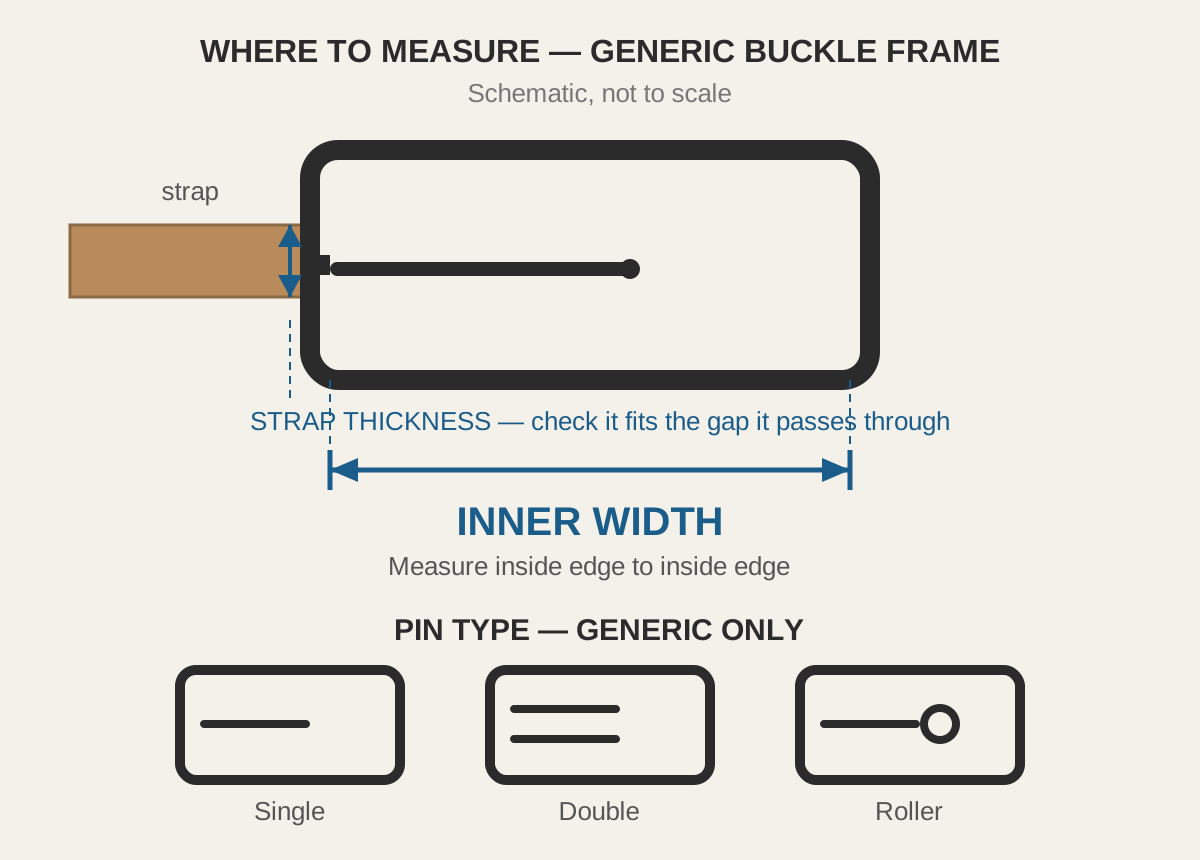
Step 3 — Set the material wording per component. Do not write "solid brass" for a whole buckle unless you have per-component evidence for it. A buckle is not one piece of metal. Frame, pin, roller, and any small fittings can be different materials. Ask about each part separately. What is the frame made of? What is the pin made of? What is the roller made of? If a part is plated, say it is plated. If a part's material is not confirmed, say it is not confirmed. This is the step most orders skip. They ask "is it brass?" and take "yes" as the answer for everything. Then one part turns out to be something else, and the whole order is argued about after delivery. Ask per component, in writing, before a sample. Keep the answer with the order.
Step 4 — Check a sample before bulk. Fit is not proven on paper. It is proven when the strap goes through the frame, the pin closes, and the buckle sits the way it should on the belt. Check the sample the same way you measured the old buckle. Same inner width. Same pin type. Same clearance for the strap thickness. If one number is off, say so plainly and fix that number. Do not accept a sample that is "close enough" on fit. Close enough on a narrow strap is still a buckle that does not fit. Only when the sample fits do you talk about bulk. Bulk first and sample later is backwards, in the wrong direction.
4. Four things to send
If you want a custom brass belt buckle made to fit, send these four things. They cut out most of the back-and-forth.
- Inner width, in millimetres.
- Pin type — single, double, or roller — and pin spacing if it is double.
- Strap width and strap thickness, in millimetres.
- One straight photo of the old buckle next to a ruler.
That is enough to check whether a standard size fits or whether it needs to be made to order. Finish and surface treatment come after fit, not before it. A buckle that does not fit in the right finish is still a buckle that does not fit.
5. Three mistakes that waste an order
First, ordering by outer width. Outside width is always bigger, by the frame thickness on both sides. Order by that number and the replacement shows up too big for your strap, every time.
Second, ordering by waist size. A belt marked 34 or 36 is talking about waist size. That number says nothing about the buckle. It will not work as a buckle size.
Third, saying only "brass" and stopping there. Brass is not a per-component answer. Frame, pin, and roller need separate answers. If you only ask about "brass" in general, you have not actually asked about the buckle you are ordering.
All three mistakes have the same root. The order was placed on a number that was never the deciding number.
6. Quick answers
Can I measure the buckle while it is still on the belt? Roughly, yes. For the final number, take it off. The strap fills the frame and reads wide.
My strap says 38 mm but a 38 mm buckle feels loose. Why? Strap width varies a little by maker and by edge finish, and so do frames. Measure both in millimetres and compare the two numbers directly, instead of trusting the label on either one.
Do I need the exact same buckle, or just the same measurements? For fit, you need the same inner width, pin type, and clearance. Style and finish can change without changing fit, as long as those three still match.
What if I do not have the old buckle anymore? Then send the belt, its width and thickness in millimetres, and a photo of the belt end next to a ruler. The measurements matter more than the old buckle itself. Without them, no one can check fit.
Related guides
How to measure a belt buckle, step by step
When a tri-glide beats a D-ring, and how to size it
This is a measuring and sourcing method, not a product test. No specific buckle, maker, or material result is claimed here. If a listing does not say whether its size is inner or outer width, or does not answer per-component material questions, ask before you order.
Contact: yuchen@varestaq.com
Varestaq is an independent sourcing and product development partner based in China. Manufacturing partners are evaluated for each project; we do not operate a factory. Supplier capability, compatibility, MOQ, tooling requirements and lead time must be verified against your actual requirements before commitment.
Discuss your part, drawing or specification