1. The problem is size and thickness, not style
A snap fastener that will not stay shut was usually not bought in the wrong style. It was bought in the wrong size for the leather it has to close, or with a post that does not suit the thickness it has to go through.
That is the most useful way to think about a snap fastener for leather. The snap is a closure, and a closure only works if the four pieces fit each other and fit the stack they close. A cap that looks right in a photo tells you nothing about either of those fits. A finish that matches your leather tells you nothing about them either.
So start from the leather, not from the catalogue page. How thick is the stack the snap has to go through, both layers together? What is the cap size you need, and what post length goes with that thickness? If you can answer those two questions, most snap problems go away before you order.
2. Four pieces, two pairs — and the listed size is only one of them
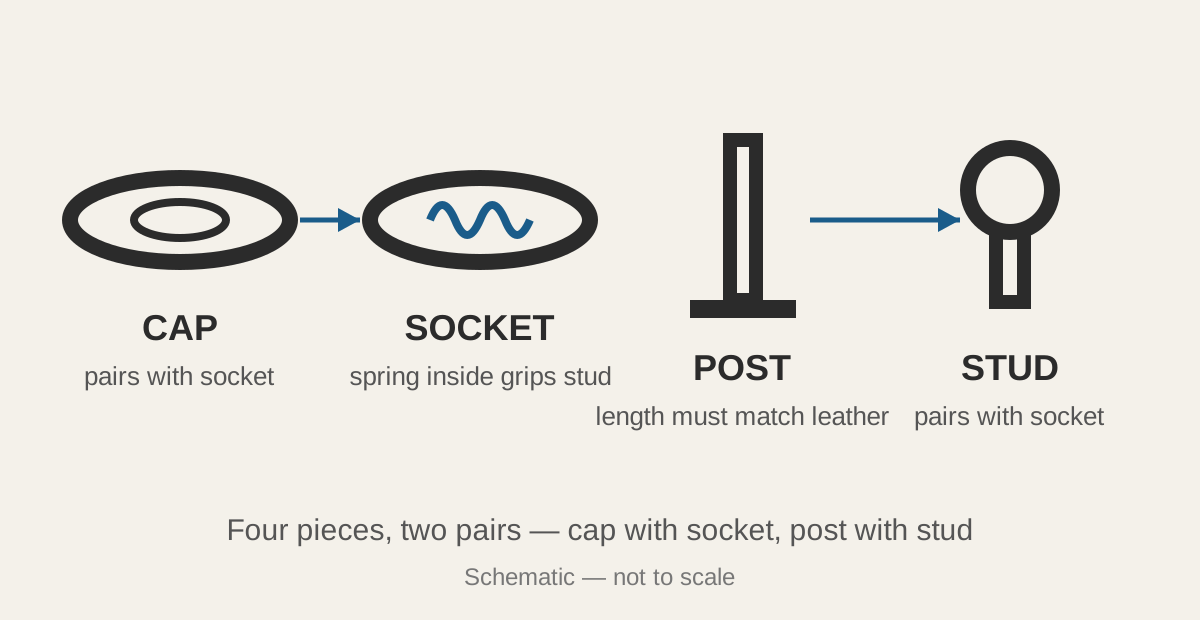
A snap fastener is four pieces, not one. The cap pairs with the socket. The post pairs with the stud. The socket holds a spring inside it, and that spring is what grips the stud when the snap closes. If any one of those four does not match the rest, the snap either will not close, or it closes once and pops open in use.
This matters because the size in a listing usually refers to only one piece. When a listing says 15 mm, it is usually talking about the cap — the piece you see on the outside. It says nothing by itself about the socket, the post, or the stud. Those three each have their own diameter, and those still have to match the set.
Snap fastener size for leather, then, is not a single number. It is a set of numbers: the cap diameter, the socket diameter, the stud diameter, and the post length. Ask the maker for the full size chart for that exact series, and check the diameter of each of the four pieces on it, not just the cap. If a chart only lists the cap, that chart is not enough to order from.
| Piece | What to check before ordering |
|---|---|
| Cap — pairs with the socket | Cap diameter — this is usually the listed size |
| Socket — pairs with the cap | Socket diameter and spring grip on the stud |
| Post — pairs with the stud | Post length against your leather thickness |
| Stud — pairs with the socket | Stud diameter against the socket spring |
3. How to match a snap fastener to leather thickness
This is where most working snaps fail, and it is the section to read twice. The question behind it is how to match snap fastener to leather thickness in practice, and it comes down to the post, and the post has to suit the thickness of the leather stack it goes through — both layers together, not one layer on its own.
A post that is too long for the stack does not pull the snap tight, and the snap works loose. A post that is too short does not reach through at all. Neither problem shows up if you test on a single scrap that is thinner than the finished piece, which is exactly how most bad tests happen.
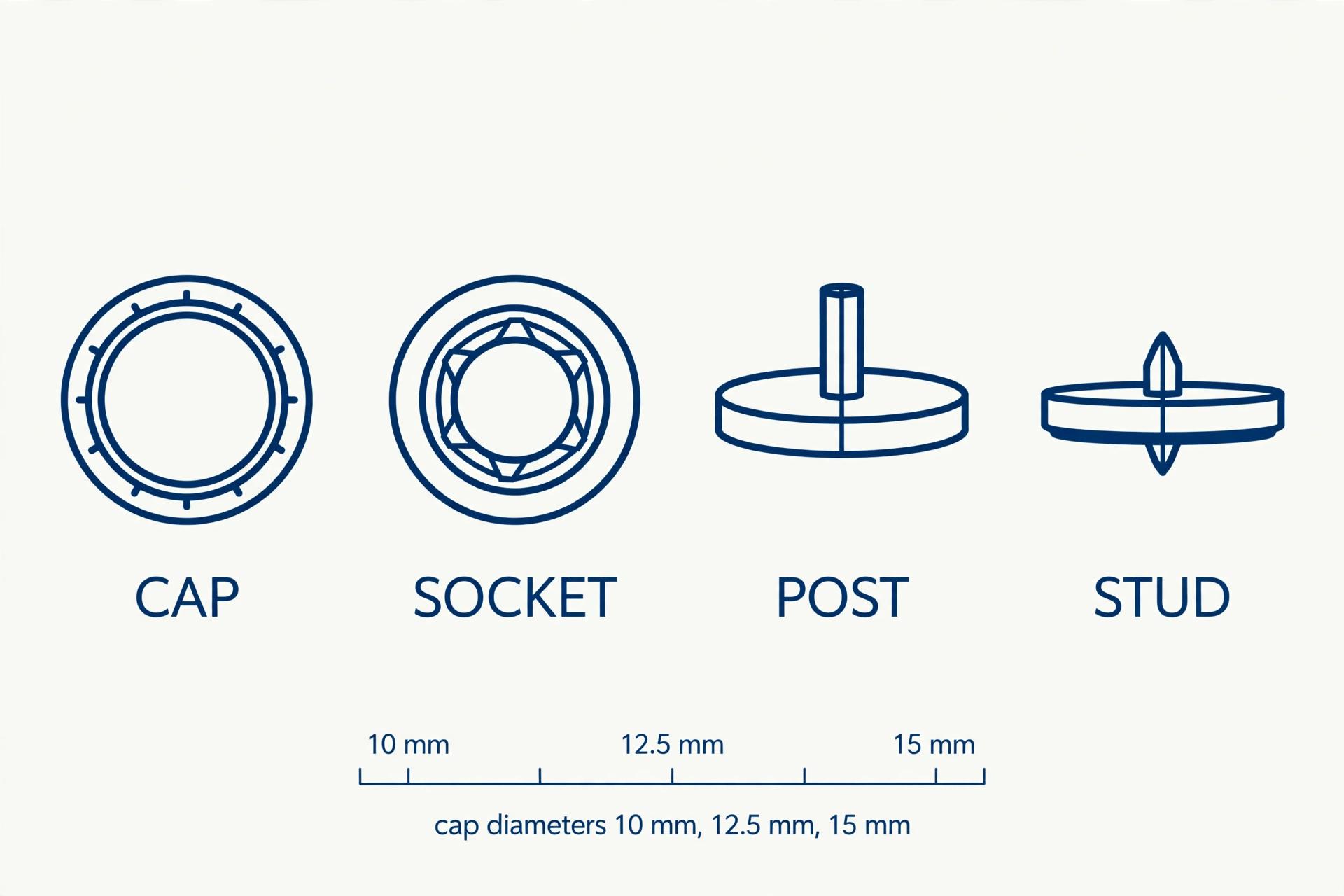
The common cap sizes give you a starting point, not an answer. A 15 mm cap is the larger end of the range most leather work uses, a 12.5 mm cap sits in the middle, and a 10 mm cap suits thinner work — but the cap size alone does not tell you the post length, and the post length is what has to match the thickness.
Test on a stack that matches the finished work: same leather, same layers, same thickness. Close it, open it, close it again, and pull it the way the finished piece will be pulled. If it only works on the test scrap, it does not work yet. If it works on the real stack, the size and the post length are both right, and the finish is a separate decision after that.
4. Ask about the spring and the material piece by piece
Snap fastener spring vs solid brass is a question worth asking in exactly those words, piece by piece, because a snap is not one piece of metal and a single material word for the whole set hides the one piece that matters most for grip.
The spring inside the socket is made to flex and grip. It is not safe to assume it is the same material as the cap, and it is not safe to assume that a listing that calls the whole set one material has checked the spring at all. If a listing calls the set "solid brass" without breaking it down by piece, ask for the breakdown before you treat that claim as settled: what is the cap made of, what is the socket made of, what is the post made of, what is the stud made of, and what is the spring made of?
Finish is a separate question from material, and it has to stay separate. A colour — antique, bright, black, gold-coloured — is a surface finish. It tells you how the snap looks, not what each piece is made of. A gold-coloured snap is not automatically a brass snap. Ask material per component, in writing, and keep the answer with the order. If a part's material is not confirmed, say it is not confirmed.
5. Match the closure type to the product, not the other way round
Leather snap closure types differ because the products differ, and the snap has to suit the job the product does. A wallet, a bag, and a knife sheath do not ask the same thing of a closure, so they should not automatically get the same snap.
A wallet snap closes a thin, flat stack that gets opened and closed many times a day. The stack is thin, the pull is light and repeated, and a snap that grips well on thin leather matters more than a snap that looks heavy. A bag snap closes a thicker stack, sometimes with a flap that gets pulled at an angle, and the post length and grip have to survive that pull without working loose. A sheath snap has a different job again: it has to hold a knife in place, so the closure must not pop open under its own weight or when the sheath is turned over. The same cap size can serve all three products, but only if the post length, the spring grip, and the stack thickness have each been checked against that product.
The practical rule is short. First, name the product and the stack. Then pick the closure that fits that stack. Then check the sample on that product, not on a scrap. A snap that closes nicely on thin scrap and pops open on the finished bag was never tested on the finished bag.
6. What to send, and quick answers
If you are asking someone else to make or supply a snap, send these and you will skip most of the back-and-forth:
- Cap diameter, in millimetres, and the maker series it comes from
- Diameter of each of the other three pieces — socket, post, and stud
- Post length, and the leather thickness stack it has to go through
- What each piece is made of, asked piece by piece, including the spring
- Finish, stated separately from material
- The product it closes, and how that product will be pulled in use
That is enough to check whether a standard set fits or whether it needs a different post length or series. Material comes piece by piece, not as one word for the whole set.
Is the listed size the size of the whole snap? No. In most listings it is the cap diameter. The socket, post, and stud each have their own diameter, and those still have to match the set.
Can I mix a cap from one maker with a socket from another? Do not count on it. Sets are made to work as a set. Test the exact four pieces together on your actual leather before you order in quantity.
Why does my snap keep popping open? Check post length against your leather thickness first, then whether the socket spring is gripping the stud. A post that is too long for the leather is the most common cause, and a mixed set is the next one.
Does finish tell me the material? No. Finish is how the snap looks. Material is what each piece is made of, and it has to be asked piece by piece, including the spring.
This is a choosing method, not a product test. No specific snap, maker, or material result is claimed here. If a listing does not break the set down by piece, ask before you order.
Related guides
Varestaq is an independent sourcing and product development partner based in China. Manufacturing partners are evaluated for each project; we do not operate a factory. Supplier capability, compatibility, MOQ, tooling requirements and lead time must be verified against your actual requirements before commitment.
Discuss your part, drawing or specification