1. One #12 measured 12 mm. Another measured 9.5 mm.
A buyer ordering #12 rivets received a drawing from one supplier showing a 12 mm cap and a 4 mm post. The buyer’s own hole punch and setter were set for the US #12: a 9.5 mm flat head and a 3.5 mm post. Same number, different rivet.
The gap looks small: 2.5 mm on the head, 0.5 mm on the post. It is not small in use. A post 0.5 mm thicker than the punch hole will not go through the leather. A post 0.5 mm thinner than the setter expects will not set tight. The head size changes the look, and whether the set sits flat.
The lesson is not that one maker is wrong. Size numbers for rivets are not one shared standard. Different makers run different series, and the same number can measure differently. Order from millimetres, not from the number.
2. The four measurements that define a rivet
A rivet is a set: rivet plus washer (burr). Four measurements define whether it fits your work: head diameter, post diameter, post length, and washer outer diameter and thickness. Measure each with calipers, in millimetres.
| Measurement | How to take it |
|---|---|
| Head diameter | Across the flat face of the head, at the widest point. This is the number most listings quote — and the only number some listings give. |
| Post diameter | Across the shank, below the head — not the tapered tip. The post is what has to pass through the hole in the leather and the washer. |
| Post length | From under the head to the tip. This is the working length: it has to match the thickness of the leather stack it goes through, plus the washer. |
| Washer (burr) | Outer diameter across the disc, and thickness at the edge. The washer spreads the load on the back of the work; its hole has to fit the post. |
Measure the actual pieces you have, not the catalogue drawing. A drawing can show the maker’s standard for that series; the pieces in your hand are the ones that have to fit your punch and setter. If you are replacing a rivet you already use, measure that one first and write the four numbers down before you ask anyone for a quote.
Snap fasteners have the same problem with numbers: a Line number is not a locked size either. See Snap Fastener Size Chart: Line 20, Line 24, and How to Pick for how to read a maker’s chart piece by piece.
3. One verified spec, worked end to end
This is one real spec, not a chart. There is no generic rivet size table on this page, because a table that pretends every maker’s #12 is the same size would be wrong.
The spec: flat head 9.5 mm; post 3.5 mm diameter × 19 mm long (3/4 inch, under head); washer about 9 mm outside diameter × about 0.75 mm thick; solid copper, C11000 (TU2 equivalent); rivet and washer supplied as a set.
Head thickness ≈1 mm is an estimate from a photo — not confirmed by calipers. It is marked as an estimate here and must be confirmed on the first sample.
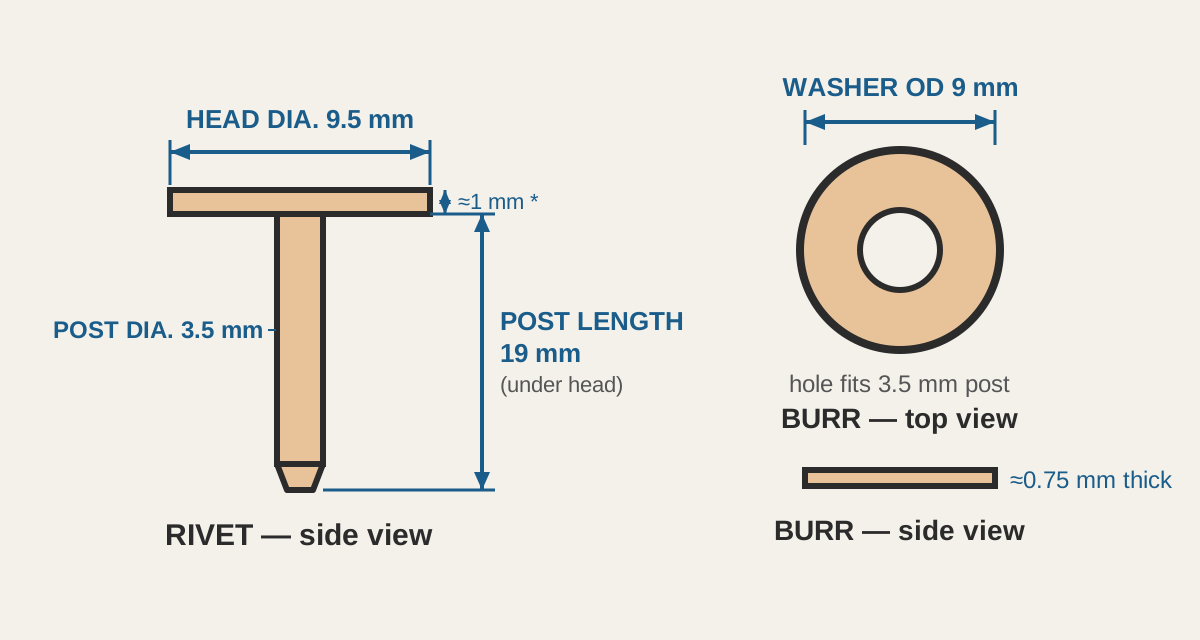
| Dimension | This spec |
|---|---|
| Head | Flat head, 9.5 mm diameter; thickness ≈1 mm (estimate — to confirm) |
| Post | 3.5 mm diameter × 19 mm long (3/4 inch, under head) |
| Washer (burr) | About 9 mm outside diameter × about 0.75 mm thick; hole to fit 3.5 mm post |
| Material | Solid copper, C11000 (TU2 equivalent); rivet and washer as a set |
Why each number matters: the 3.5 mm post has to pass a hole punched for 3.5 mm — a 4 mm post will not go through. The 19 mm length has to cover the leather stack plus the washer — too short and it will not reach through, too long and it will not set tight. The 9 mm washer spreads the load — a washer much smaller leaves the rivet pulling through, and a washer much larger changes the look on the back.
4. What to confirm in writing before you order
Ask for all four numbers in millimetres, in writing, for the exact series you are ordering: head diameter, post diameter, post length (under head), washer outer diameter and thickness — and whether the washer is included in the set. Ask what each piece is made of, piece by piece. Keep the written answer with the order.
If a listing gives only “#12”, that is not an answer yet. Ask for the four numbers. If the maker sends a drawing, check the numbers on it against your own measurements — a drawing for a different series from the same maker is the wrong drawing.
If the numbers come back different from the ones your tools are set for, stop and check the fit before you order: does the post go through your punch hole, does the setter close it tight on your leather stack, does the washer sit flat? A sample set answers that faster than another round of messages.
Material is asked the same way: piece by piece, in writing. For how to ask about material, and how solid brass differs from brass-plated hardware, see Brass Hardware Sourcing.
5. Pre-order checklist
- Head diameter, in millimetres, for the exact series
- Post diameter, in millimetres — measured across the shank, not the tip
- Post length, under the head, against your leather thickness stack
- Washer outer diameter and thickness, and whether the washer is included in the set
- What each piece is made of, asked piece by piece, in writing
- The written answer kept with the order
This is a measuring method, not a product test. No specific rivet, maker, or material result is claimed here beyond the one spec shown above.
Related guides
Snap Fastener Size Chart: Line 20, Line 24, and How to Pick
Contact: yuchen@varestaq.com
Varestaq is an independent sourcing and product development partner based in China. Manufacturing partners are evaluated for each project; we do not operate a factory. Supplier capability, compatibility, MOQ, tooling requirements and lead time must be verified against your actual requirements before commitment.
Discuss your part, drawing or specification